
ARCHAEOMETRIC ANALYSES
- DATING
- PROVENANCE ANALYSIS
- AUTHENTICITY ASSESSMENT
The Laboratory provides dating services for archaeological and geological materials using luminescence methods, primarily Thermoluminescence (TL) and Optically Stimulated Luminescence (OSL). These methods are applied to materials containing minerals such as quartz or feldspars, which exhibit luminescent properties.
Luminescence dating is based on the natural ability of certain crystalline minerals to store energy from natural ionising radiation in the environment (from cosmic radiation and radioactive elements such as U, Th and K) within their crystal lattice. Over time, trapped electrons accumulate at defects in the crystal lattice. When the minerals are stimulated in the laboratory by heat or light, the electrons are released and luminescence is emitted. Its intensity is proportional to the total radiation dose absorbed by the material. This information is used to calculate the time elapsed since the last event that “reset” the luminescence signal.
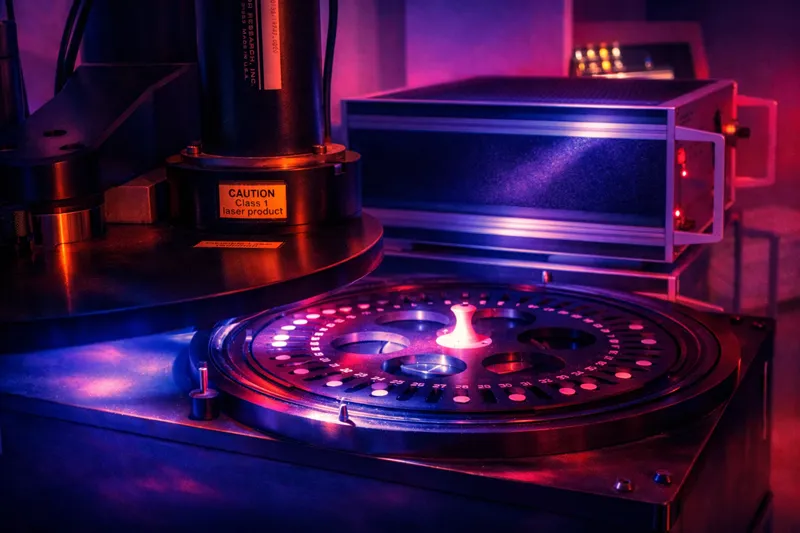
Thermoluminescence – TL
In thermoluminescence, the luminescence signal is released by heating the sample in the laboratory. This technique is used mainly for materials that were heated in the past to relatively high temperatures (>400 °C), such as ceramics, fired bricks, or burnt archaeological materials.
In such cases, the date corresponds to the time elapsed since the material was last heated to a high temperature; for archaeological ceramics, this is usually the time of firing in the kiln.
Optically Stimulated Luminescence – OSL
In optically stimulated luminescence, the luminescence signal is stimulated using light of a specific wavelength. The method is used mainly for sediments and materials containing quartz or feldspars.
OSL dating determines the time elapsed since the grains of the material were last exposed to natural light (sunlight) before burial. In other words, exposure to light “resets” the luminescence signal, and radiation begins to accumulate again from the time of burial.
Analysis Procedure and Time Required
Luminescence dating is a complex and time-consuming laboratory procedure, involving several stages, including:
- careful preparation of samples under controlled lighting conditions
- separation and selection of the appropriate grain-size fraction
- measurement of luminescence using specialised instruments
- calibration of the sample’s response to radiation
- calculation of the equivalent dose (De), corresponding to the accumulated absorbed dose stored in the material (palaeodose)
- estimation of the concentrations of natural radionuclides in the sample and its surrounding environment
- estimation of the cosmic-radiation contribution
- calculation of the annual dose rate (D) from the contributions listed above
The final “age” is derived from the relationship between the total stored radiation dose and the rate at which it accumulates in the natural environment.
Sampling
Correct sampling is critical to the reliability of the dating result. When sampling is carried out by the client, such as an archaeologist or researcher, the Laboratory provides detailed sampling instructions in order to:
- avoid inadvertent exposure of the samples to light
- collect the necessary accompanying samples for calculating the environmental radiation dose rate
- ensure the highest possible accuracy of the results
Applications in Archaeology
TL and OSL methods are widely used in archaeology and archaeometry for dating:
- ceramic objects
- archaeological kilns or burnt surfaces
- fired bricks and building materials
- sediments associated with archaeological layers
These methods provide absolute age estimates and can cover periods ranging from several hundred to several hundred thousand years, depending on the material and the conditions.
The Laboratory of Archaeometry and Physicochemical Measurements (APML) provides provenance analysis services for ceramic materials using elemental analysis and multivariate statistical analysis of the data. This approach is widely used in archaeometry to investigate the provenance of raw materials and identify possible production centres for ceramic objects.
The fundamental principle of the method is that clays originating from the same geological environment exhibit a similar chemical composition. Consequently, ceramics manufactured from the same or similar clay display a comparable elemental “chemical fingerprint” and are likely to originate from the same area or from workshops that used the same raw material.
For this purpose, elemental analysis of the ceramic samples is performed to determine the concentrations of a large number of chemical elements. Trace elements are particularly important in provenance studies, as they often act as highly distinctive indicators of the geological material and can differentiate clays with similar major-element compositions.
Statistical Analysis and Sample Grouping
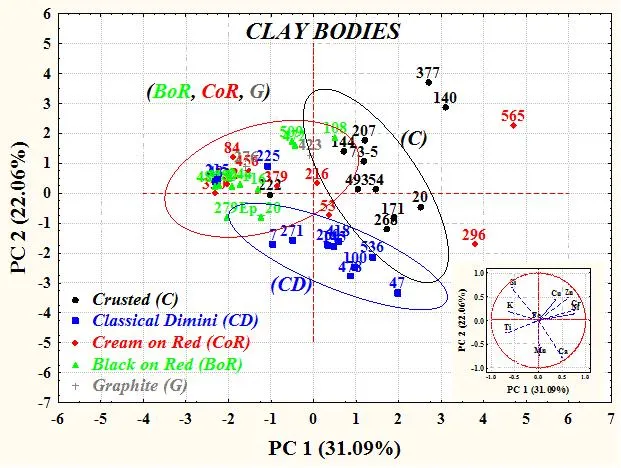
Ceramic samples are not compared simply by directly examining elemental concentrations; instead, the comparison is carried out using multivariate statistical methods. The most commonly used techniques include:
- Principal Component Analysis (PCA)
- Hierarchical cluster analysis and dendrograms
These methods enable samples to be grouped according to their chemical similarity, revealing groups of ceramics that may share a common raw-material provenance. This makes it possible to determine whether different archaeological finds originated from the same production centre or from different regions.
It is important to emphasise that these analyses do not directly identify the exact geographical location where a ceramic object was produced. Instead, they allow groups of samples with common or different provenance to be identified on the basis of the chemical composition of the clay.
Role of Reference Samples
The interpretation of the results can be significantly strengthened when reference samples are available. These are ceramics of already known provenance, for example:
- ceramics belonging to specific typological categories (e.g. Attic pottery)
- materials recovered from archaeological kilns or production sites, where the provenance is considered certain
In such cases, unknown samples can be compared with the reference samples using statistical methods, providing strong evidence regarding their probable provenance or production centre.
Applications in Archaeology
Ceramic provenance analysis is an important tool for investigating:
- ceramic production centres
- trade and distribution networks for goods in antiquity
- technological traditions and production workshops
- cultural and economic contacts between different regions
The combined use of elemental analysis and statistical methods enables the identification of chemical “groups” of ceramics and makes an important contribution to understanding the production and circulation of ceramic objects in the ancient world.
The Laboratory of Archaeometry and Physicochemical Measurements (APML) provides authenticity assessment services for ceramic and other archaeological objects, primarily using luminescence methods, such as Thermoluminescence (TL). This method is one of the most reliable techniques used internationally to distinguish authentic ancient objects from modern imitations.
Authenticity assessment is based on the same physical principle as luminescence dating. Certain crystalline minerals contained in ceramic clay, mainly quartz and feldspars, can store energy from natural ionising radiation in the environment within their crystal lattice. Over time, trapped electrons accumulate at defects in the mineral lattice.
When a ceramic object is heated to a high temperature during firing in a kiln, its luminescence signal is reset. From that moment onwards, energy from natural environmental radiation begins to accumulate again. In the laboratory, controlled heating of the sample releases the trapped electrons, producing luminescence whose intensity is proportional to the accumulated radiation dose.
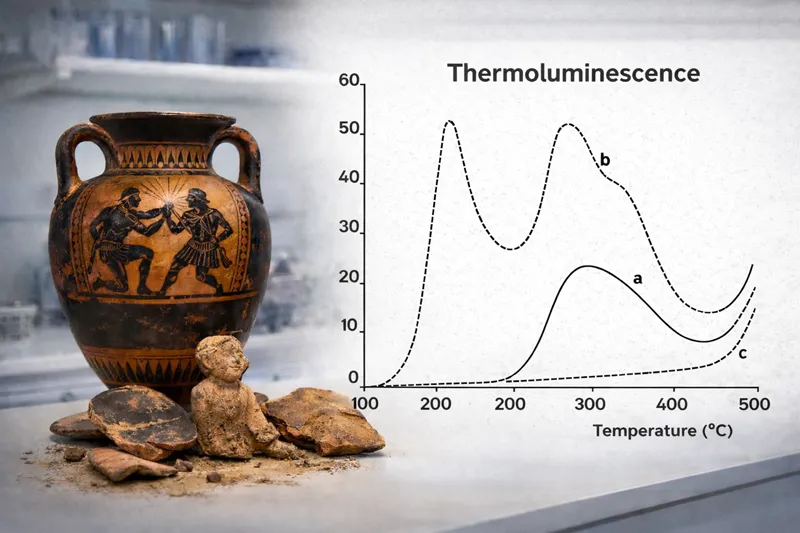
Typical thermoluminescence (TL) glow curves used for the authenticity assessment of ceramic objects. Curve (a) corresponds to the natural thermoluminescence of a powder sample taken from the object, curve (b) to a laboratory-induced glow curve following artificial irradiation of the sample, while curve (c) represents the background signal of the measurement system.
Distinguishing Authentic from Modern Objects
The fundamental principle of authenticity assessment is that an authentic ancient ceramic object, having remained in the natural environment for hundreds or thousands of years after firing, has had sufficient time to accumulate a significant luminescence signal.
In contrast, a modern object or imitation, produced recently, has not had sufficient time to accumulate a significant radiation dose and therefore exhibits a very weak or virtually absent luminescence signal.
By measuring the intensity of the thermoluminescence signal and comparing it with the expected natural radiation dose, it is possible to determine whether the object’s age is compatible with that of an archaeological artefact or whether it is of modern manufacture.
Limitations and Interpretation of Results
In the context of authenticity assessment, thermoluminescence is not necessarily used to determine the precise age of an object. Rather, it is used mainly to establish whether the accumulated radiation dose is consistent with a substantial archaeological age or indicates recent firing.
The interpretation of the results considers several factors, including:
- the composition and mineralogical characteristics of the clay
- the burial conditions and the environment in which the object was found
- the natural radioactivity of the surrounding material
- any subsequent exposure to heat
Applications
Thermoluminescence-based authenticity assessment is applied primarily to:
- ceramic vessels and figurines
- fired bricks and ceramic building materials
The method is widely used by archaeological authorities, museums, collections, and auction houses to document the authenticity of objects and help prevent the circulation of modern imitations.
Combining luminescence analysis with other archaeometric and physicochemical techniques can provide an integrated scientific assessment of an object’s authenticity, thereby making a meaningful contribution to the protection of cultural heritage.