
PHYSICOCHEMICAL ANALYSES
- ELEMENTAL ANALYSIS
- MOLECULAR SPECTROSCOPIC ANALYSIS
- NITROGEN DETERMINATION
- ORGANIC COMPOUND ANALYSIS
The Laboratory provides elemental analysis for a variety of samples, using either X-ray Fluorescence Spectroscopy (XRF) for rapid, multi-element, non-destructive analysis of solids or Atomic Absorption Spectroscopy (AAS) for high-accuracy quantitative determination in liquid samples or samples following dissolution. Complementary techniques may also be used depending on the application. The appropriate method is selected according to the sample type and the required level of accuracy.
Elemental analysis is based on the interaction of matter with electromagnetic radiation or on atomic and ionic phenomena that produce characteristic energy emission or absorption by chemical elements.
- In X-ray fluorescence spectroscopy (XRF), atoms are excited and emit characteristic X-rays that are unique to each element.
- In atomic absorption spectroscopy (AAS), atoms absorb radiation at a specific wavelength, enabling their accurate quantitative determination.
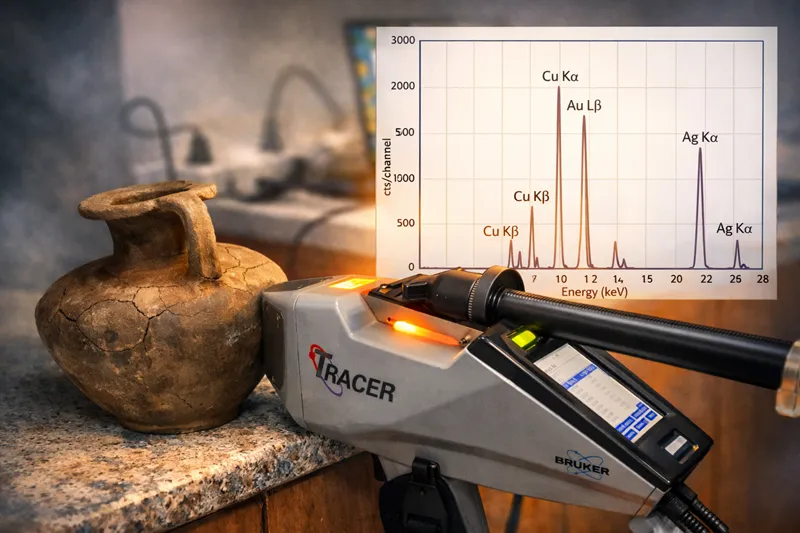
The intensity of the signal is directly related to the concentration of the element in the sample.
Information Provided
The analysis enables:
- Determination of elemental composition (major and trace elements)
- Quantitative determination of concentrations
- Assessment of the purity of materials and alloys
- Identification of impurities or contaminants
- Comparison of samples for provenance or manufacturing-technology studies
Sample Types
The service can be applied to:
- Solid materials: metals, alloys, ceramics, glass, and archaeological objects
- Environmental samples: soils, sediments, and dusts
- Liquid samples: water, solutions, and extracts
- Food and industrial products
Applications
- Archaeometric studies (provenance and manufacturing technology)
- Authenticity assessment and characterisation of cultural heritage materials
- Environmental monitoring and pollution assessment
- Quality control of industrial materials and products
- Determination of metal purity (e.g. gold and silver)
- Support for research and technology projects
Molecular spectroscopic analysis is used to determine the chemical composition and molecular structure of organic and inorganic compounds in a wide range of materials. Its purpose is to identify functional groups and investigate the composition of complex materials, contributing to an understanding of the chemical processes associated with their formation, use, or alteration.
For this purpose, the Laboratory uses spectroscopic techniques such as Fourier-Transform Near-Infrared Spectroscopy (FT-NIR) and Ultraviolet-Visible Spectroscopy (UV-Vis). FT-NIR is particularly suitable for organic materials and their qualitative characterisation, enabling rapid analysis with minimal or no preparation, including the analysis of solid samples. UV-Vis is used to determine compounds containing chromophoric groups, primarily in solution.
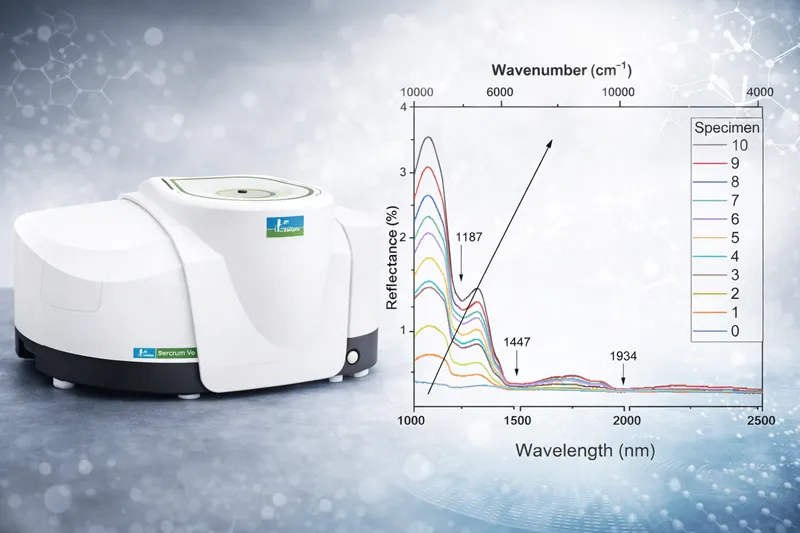
Molecular spectroscopy is based on the interaction of matter with electromagnetic radiation. Each molecule absorbs or emits radiation at specific wavelengths associated with the vibrations and electronic transitions of its bonds. The resulting spectrum constitutes a characteristic molecular fingerprint of the material.
- Near-infrared spectroscopy (FT-NIR) primarily records vibrational transitions associated with organic compounds.
- UV-Vis spectroscopy records electronic transitions associated with chromophoric groups and inorganic or organic complexes.
Information Provided
- Identification of organic compounds and functional groups
- Information on molecular structure and composition
- Characterisation of complex materials and mixtures
- Detection of changes caused by ageing, deterioration, or processing
- Qualitative and, in certain cases, quantitative estimation of constituents
Sample Types
- Cultural heritage materials and archaeological finds
- Organic residues, binding media, and pigments
- Environmental samples
- Food and natural products
- Materials of research and technological interest
Applications
- Material characterisation and investigation of chemical composition
- Analysis of organic constituents in complex systems
- Quality control of food and natural products
- Monitoring of chemical changes in environmental samples
- Support for research and technological applications
-
Archaeometry:
- ✓ Identification of organic materials (binding media, resins, pigments)
- ✓ Investigation of manufacturing technologies and material use
- ✓ Investigation of deterioration and ageing processes
The Laboratory provides nitrogen determination services, measuring the nitrogen content of samples. Nitrogen is particularly important in assessing the chemical composition of organic materials. Nitrogen determination is widely used to estimate protein content, characterise biological and agricultural materials, and support quality-control applications for food and animal feed.
Analyses are performed using a fully automated Kjeldahl system, which provides high accuracy in quantitative determination and is suitable for a wide range of organic samples. The method is destructive because it requires complete chemical decomposition of the sample during digestion.
Analysis by the Kjeldahl method, one of the most reliable and established techniques for determining total nitrogen, involves the following stages:
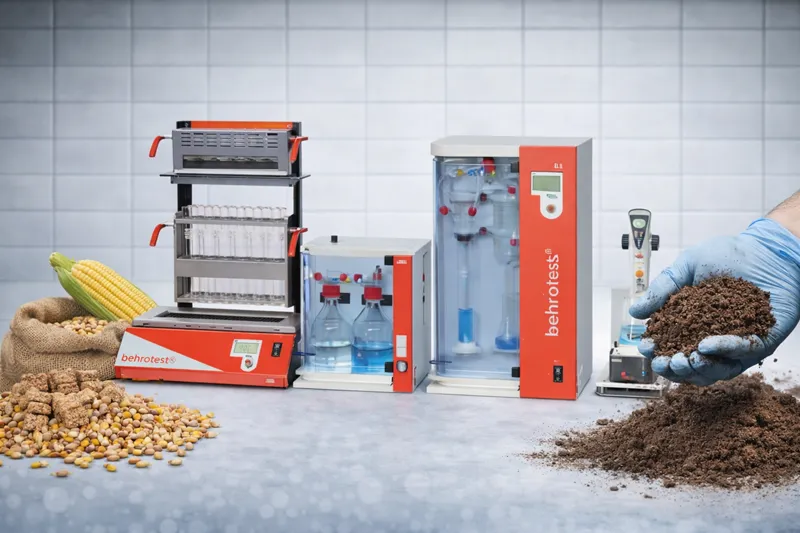
- chemical decomposition (digestion) of the sample
- conversion of nitrogen into ammonia
- distillation and collection of the product
- titration for quantitative determination
Information Provided
- Quantitative determination of total nitrogen
- Estimation of protein content using appropriate conversion factors
- Characterisation of organic and biological materials
- Assessment of quality and nutritional value
Sample Types
- Food and animal feed
- Agricultural products
- Soils and environmental samples
- Plant and microbial biomass
- Biological materials
- Organic samples of research or industrial interest
Applications
- Quality control of food and animal feed
- Estimation of protein composition
- Agricultural and environmental studies
- Characterisation of organic and biological materials
- Support for research and industrial applications
The Laboratory provides organic compound analysis services for the determination, identification, and characterisation of organic constituents in a wide range of samples. The aim is to investigate the chemical composition and structure of organic compounds, supporting research applications, environmental studies, and quality-control procedures.
The analysis is based on the separation of organic compounds and their detection using highly sensitive spectrometric techniques. For this purpose, the Laboratory is equipped with an advanced Liquid Chromatography system coupled with triple-quadrupole tandem Mass Spectrometry (LC-MS/MS).
Liquid chromatography (LC) separates the individual constituents of a sample, while tandem mass spectrometry (MS/MS) provides information on the molecular mass and structure of the compounds. The combination of LC-MS/MS enables the simultaneous detection of numerous compounds with high sensitivity and selectivity, even at trace levels.
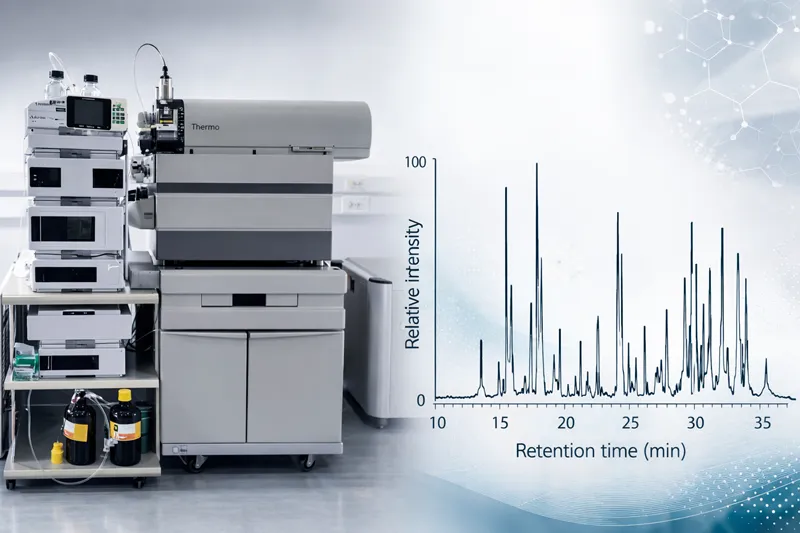
The method is destructive, as it requires extraction and chemical preparation of the sample before analysis. In specific cases, minimally invasive sampling procedures are applied to reduce alteration of the sample.
Information Provided
- Qualitative determination and identification of organic compounds
- High-accuracy quantitative determination of concentrations
- Detection of compounds at very low concentrations (trace analysis)
- Characterisation of complex mixtures
- Information on molecular structure and composition
Sample Types
- Environmental samples (water, wastewater, sediments)
- Food and natural products
- Pharmaceutical and biological samples
- Agricultural samples
- Materials of industrial or research interest
- Archaeological samples (organic residues)
Applications
- Environmental monitoring and detection of organic pollutants
- Quality control of food and pharmaceutical products
- Analysis of natural products and bioactive compounds
- Detection of residues (e.g. pesticides and organic pollutants)
- Support for research and technology projects
-
Archaeometry:
- ✓ Characterisation of organic residues in archaeological finds
- ✓ Analysis of lipids, resins, and food residues
- ✓ Investigation of material uses and dietary practices in ancient societies