
RADIOLOGICAL MEASUREMENTS
- DETERMINATION OF NATURAL RADIONUCLIDES
- RADIATION DOSE CALCULATION (DOSIMETRY)
Natural radionuclides are determined at the Laboratory of Archaeometry and Physicochemical Measurements using high-resolution gamma-ray spectrometry. The technique enables the identification and quantitative determination of radioactive isotopes that occur naturally in environmental materials.
The measurement is based on recording gamma rays emitted during the radioactive decay of atomic nuclei. Each radionuclide emits gamma rays at specific energies, which act as its characteristic spectral fingerprint. A high-resolution gamma-ray spectrometer, such as a high-purity germanium (HPGe) detector, records the radiation energy spectrum, enabling:
- identification of radionuclides
- calculation of their activity in the sample
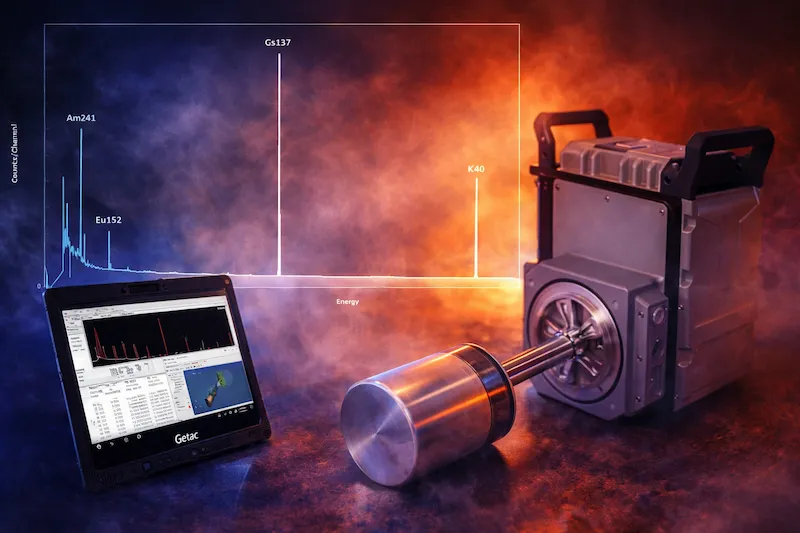
Gamma-ray spectrometry is a non-destructive technique, as the sample is not altered during measurement and can subsequently be used for other analyses.
The method enables the determination of natural radionuclides belonging mainly to the natural decay series:
- U-238
- Th-232
- Ra-226
- K-40
as well as other radioisotopes occurring in the environment.
Sample Types
Solid Samples
- soils and sediments
- rocks and building materials
- ceramics and archaeological objects
- ashes and industrial residues
- food and agricultural products
Liquid Samples
- drinking water
- natural waters (rivers, lakes, groundwater)
- industrial or environmental liquid samples
Radon Measurements
As part of its radiological measurement services, the Laboratory can also measure radon (Rn-222) concentrations in indoor environments, including homes, schools, and workplaces.
Radon is a naturally occurring radioactive gas produced by the decay of uranium in the ground and may accumulate in enclosed spaces. Monitoring radon levels is important for:
- estimating the radiological exposure of the population
- assessing indoor air quality
- identifying buildings with elevated radon concentrations
Applications
The determination of natural radionuclides has applications in many fields, including:
- environmental studies and monitoring of natural radioactivity
- testing of building materials and raw materials
- geological and geochemical investigations
- archaeometric studies and material dating
- testing of food and agricultural products
- assessment of radiological exposure in homes and workplaces
The Laboratory of Archaeometry and Physicochemical Measurements provides services for calculating ionising-radiation doses in materials and environmental samples using modern dosimetric techniques and specialised equipment.
Dosimetry enables assessment of the radiological exposure received by a material or environment from natural or anthropogenic radiation sources. Measurements are performed using techniques such as Thermoluminescence (TL), Optically Stimulated Luminescence (OSL), and gamma-ray spectrometry, which record the energy stored in dosimetric materials because of exposure to ionising radiation.
These measurements can be used to calculate:
- the absorbed radiation dose in a material
- the natural-radiation dose rate in the environment
- the contribution of different radionuclides to background radiation
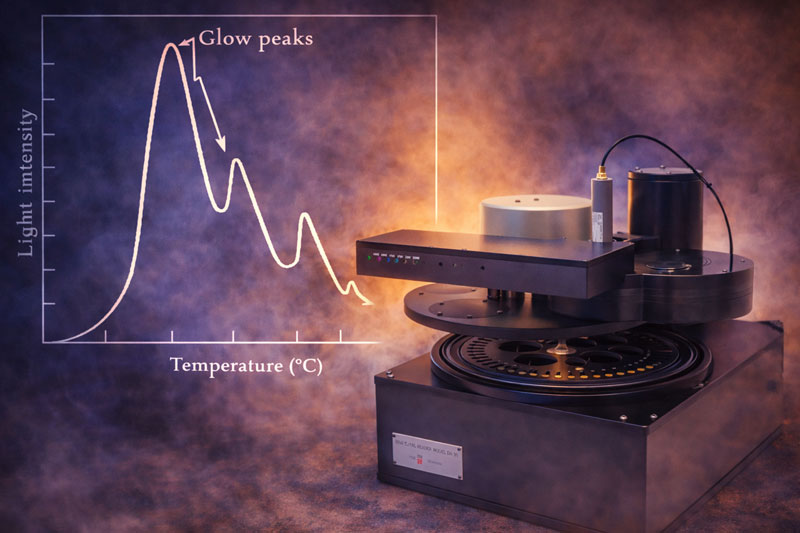
The analyses are applied mainly to solid materials, including:
- ceramics and archaeological objects
- soils and sediments
- rocks and minerals
- building materials
- geological samples
Dosimetric analysis is generally a semi-destructive technique, as a small quantity of material is required for measurement.
Indicative Applications
The dosimetry service is used in:
- archaeometric and geochronological studies
- environmental radiology
- assessment of natural background radiation
- testing of building materials
- geological and geophysical investigations
- assessment of radiological exposure in natural and artificial environments
Measurements are performed with high accuracy and can support research projects, environmental studies, and technical applications associated with natural radioactivity and radiological safety.