
ΔΙΑΚΡΙΣΕΙΣ ΕΡΓΑΣΤΗΡΙΟΥ
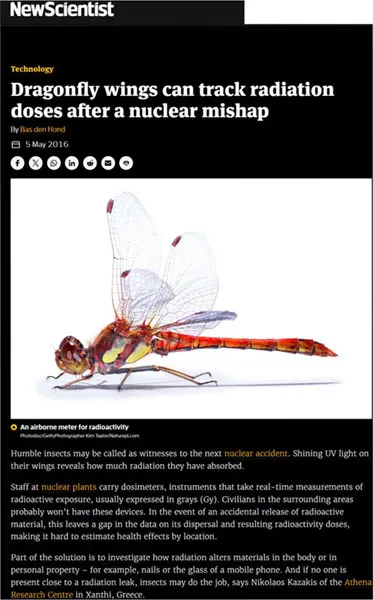
An extensive feature in the internationally renowned popular science magazine New Scientist presented our published research on the use of dragonfly and housefly wings as radiation dosimeters.
Our research proposes the use of insect wings as dosimeters for determining the radiation dose released following a nuclear accident or in the context of forensic investigations involving the suspected presence or use of radioactive materials. The method is based on Optically Stimulated Luminescence (OSL).
- Original Scientific Publication:
Kazakis, N.A., Anastasia Th. Tsetine, Kitis, G., Tsirliganis, N.C., 2016. “Insect wings as accidental/retrospective dosimeters: An optically stimulated luminescence investigation”. Radiation Measurements 89, 74-81.
- Printed Feature:
Kazakis, N.A., Anastasia Th. Tsetine, Kitis, G., Tsirliganis, N.C., 2016. “Insect wings as accidental/retrospective dosimeters: An optically stimulated luminescence investigation”. Radiation Measurements 89, 74-81.
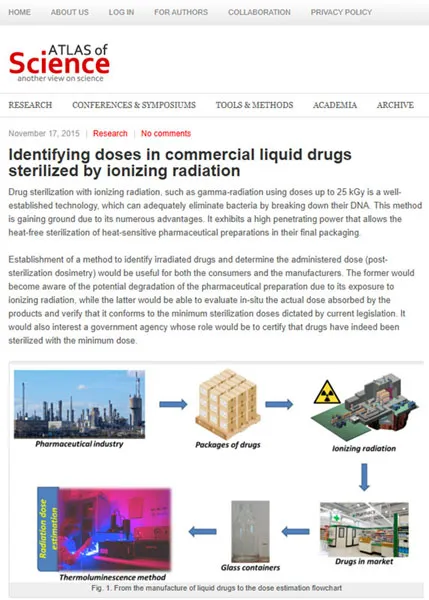
An extended summary of our research was published in Atlas of Science, a scientific communication platform aiming to present complex scientific concepts and discoveries to a broader audience beyond the scientific community.
The study presents a preliminary investigation into the potential use of thermoluminescence in commercial glass containers for liquid pharmaceutical products, with the aim of determining the radiation dose applied during the radiation sterilization of liquid pharmaceuticals.
- Original Scientific Publication:
Kazakis, N.A., Kitis, G., Tsirliganis, N.C., 2015. Preliminary thermoluminescence investigation of commercial pharmaceutical glass containers towards the sterilization dosimetry of liquid drugs. Applied Radiation and Isotopes 105, 130-138.
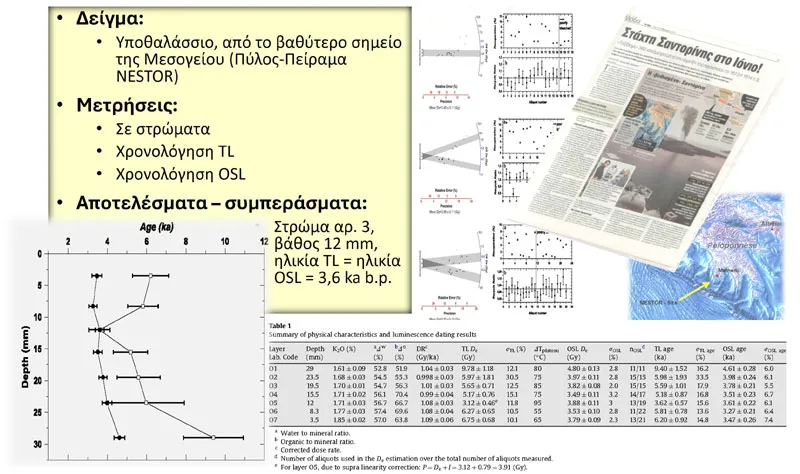
Marine sediments collected from a deep-sea core at a depth of approximately 4,000 m at the NESTOR site, east of the Hellenic Trench and southwest of the Peloponnese, were analyzed and dated using Optically Stimulated Luminescence and Thermoluminescence methods.
The results indicated that layer O5 dates to approximately 3.6 thousand years before present, corresponding chronologically to the major eruption of the Santorini volcano around 1600 BC.
The agreement between the two independent methods, OSL and TL, together with the geochemical characteristics of the sample, confirms that this layer consists of volcanic ash, or tephra, originating from the Santorini eruption.
- Original Scientific Publication:
George S. Polymeris, George Kitis, Anastasios K. Liolios, Anastasios Sakalis, Konstantin Zioutas, Efstratios G. Anassontzis, Nestor C. Tsirliganis. Luminescence dating of the top of a deep water core from the NESTOR site near the Hellenic Trench, east Mediterranean Sea, Volume 4, Issue 1, 2009, Pages 68-81, ISSN 1871-014.