
Artificial Intelligence & Computational Applications in the Natural Sciences
Research in Artificial Intelligence and Computational Applications in the Natural Sciences concerns the development of algorithmic and computational approaches for processing complex experimental data and modeling physical, chemical, environmental, and biological processes. The research combines machine-learning techniques, data analysis, computer vision, and automated processing of experimental data to extract knowledge from complex, multiparametric systems.
The research activities include the development of predictive models and machine-learning algorithms for analyzing large volumes of experimental and environmental data, as well as the investigation of relationships between physicochemical parameters and dynamic processes. The activities include applications of supervised and unsupervised learning, multivariate analysis, and the development of hybrid models that combine experimental data with physics-informed or empirical approaches.
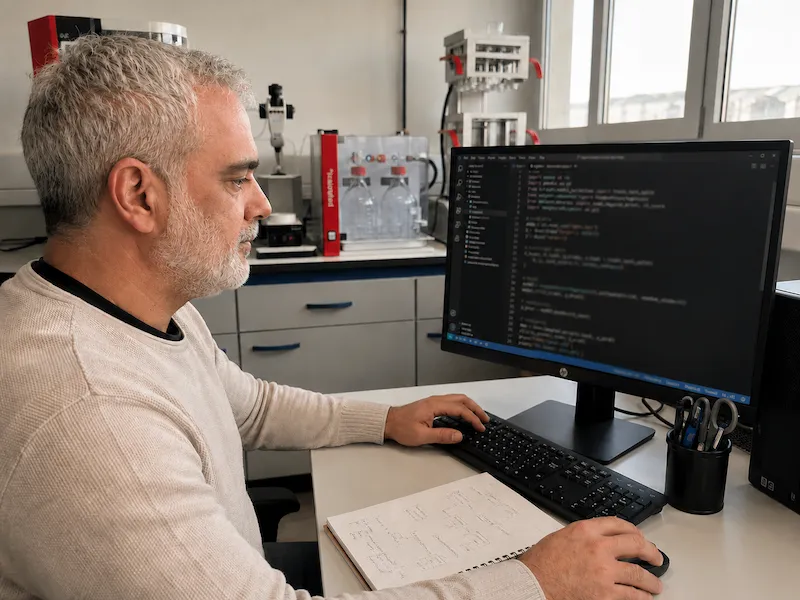
In conjunction with the above, the Laboratory develops computer-vision and image-processing applications for the automated analysis of imaging data obtained from microscopy, multispectral, and other imaging systems. The research includes the development of algorithms for pattern recognition, feature extraction, classification, automated quantification, and change detection in natural and biological systems, including, for example, the automated analysis and counting of microbial or cellular structures.
The research also extends to the development of specialized computational tools for processing and interpreting complex experimental data in the natural sciences. These activities include the development of software and algorithmic approaches for analyzing spectroscopic, luminescence, and other experimental responses, fitting mathematical models, and deconvoluting complex luminescence curves in support of research and analytical procedures.
The Laboratory’s research also places significant emphasis on the development of intelligent digital platforms and integrated monitoring and decision-support systems through the interconnection of sensors, IoT technologies, and ubiquitous computing. These approaches support real-time applications, automated data processing, and the development of adaptive systems for research and technological applications in the natural sciences.
Finally, modern approaches to explainable artificial intelligence (Explainable AI), model-reliability analysis, and the development of tools that support research processes are investigated with the aim of improving the interpretability and practical use of computational models in interdisciplinary environments.