
PROJECTS
DURATION: 2017-2021
FUNDING: Operational Programme Competitiveness, Entrepreneurship and Innovation, PRIORITY AXIS 03: Development of mechanisms supporting entrepreneurship, strategic development action for research and technology organizations
Subproject 2 of Action “Computational Science and Technologies: Data, Content and Interaction” (Drasi “Athena” R.C.)
The proposed subproject primarily concerns applications of science and new technologies for understanding, documentation, authentication, and promotion of cultural heritage assets. Its objective is to contribute to the enhancement, management, and exploitation of these assets through processes that combine traditional methods, such as archaeological study, with modern applications of computer science and information technology.
The subproject focuses thematically on presenting archaeological research relating to Aegean Thrace and northern Greece. This is addressed through research on the specific region and through comparisons with other areas of the ancient world. The project is implemented through an interdisciplinary approach combining traditional methods of archaeological research with the use of new technologies.
The intention is: (a) to provide researchers studying ancient Aegean Thrace with an integrated perspective that includes spatial and temporal dimensions and facilitates their scientific work; and (b) to offer the wider public, including residents, visitors, families, educators, and students, a means of better understanding and engaging with archaeological knowledge concerning Aegean Thrace in antiquity.
Through this interdisciplinary approach, the project aims to create a platform in which: (1) available archaeological publications concerning Aegean Thrace are collected, including information on settlements, cemeteries, excavations, archaeological sites, museum exhibits, and ancient sources; (2) this material is presented online by location, chronological period, and/or theme, such as ceramics, architecture, and sculpture; and (3) archaeological information is provided in the form of educational programmes, including resources for teachers and parents, games, and related material.
A further objective is to create an openly available multilingual cultural thesaurus suitable for use in cultural and tourism projects and products. The thesaurus is developed within an appropriate lexicographic environment with crowdsourcing capabilities and covers the semantic domains of visual arts and architecture, as well as gastronomy. Both the visual-architectural and gastronomic vocabularies are included. These domains are highly relevant to cultural and tourism applications, support the inclusion of Greek in linked cultural data, and enable comparative examination of Greek and Anglo-Saxon cultures regarding the conceptualization of the world.
The potential offered by new technologies, intelligent systems, and multimedia in the cultural field is explored mainly in relation to content-based retrieval of 3D data, virtual multi-agent environments with adaptive narrative storytelling, automatic music-information retrieval, and the processing and recognition of images and handwritten text.
The aim is to develop new or improved methods and techniques for processing and analyzing multimedia data, including 3D data, music, virtual environments, images, and video, in order to extract knowledge. The longer-term objective is to improve interaction environments and enable more efficient retrieval and personalized access. All newly developed techniques are evaluated against the most effective and up-to-date methods reported in international literature. In addition, all activities are integrated into pilot online environments accessible to both researchers and general users.
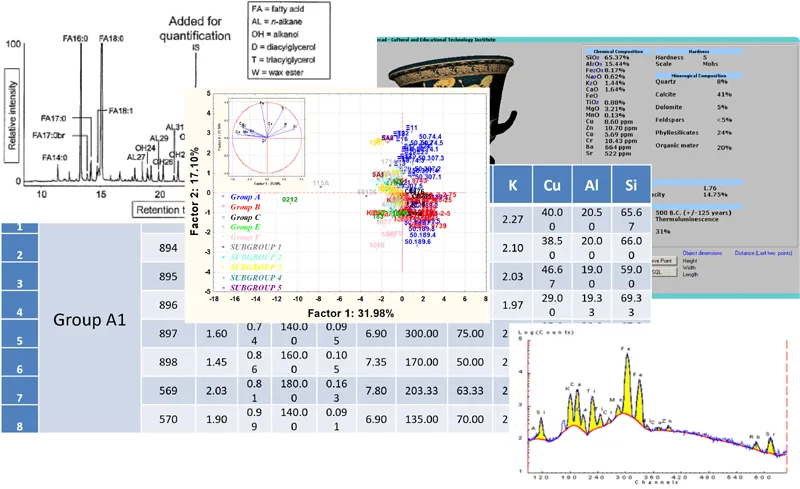
The contribution of the natural sciences to contemporary cultural research focuses on the opportunities for assessing, documenting, and authenticating cultural heritage assets through the analysis and systematization of the physicochemical properties, particularly luminescence-related properties, of materials found in cultural objects and monuments.
The project investigates selected geological building materials, such as marble and slate; geological materials that are constituents of clays, such as quartz and clay minerals; and biological materials, such as bones. The selected materials are of particular interest because of their uses and their potential for innovative applications extending beyond the cultural sector. For example, marble is both a material used in monuments and works of art and a modern building material of significant commercial value, while bones are archaeological finds that may also be used in accident dosimetry.
The complete set of results is systematized and recorded in an appropriate scientific database following international scientific-metadata standards. This enables the results to be used in a range of cultural studies, including dating, provenance studies of materials and objects such as quartz and marble, and the determination of firing temperatures using quartz, as well as in related scientific fields such as accident dosimetry and the dosimetry of food and pharmaceutical sterilization, which have attracted considerable international scientific interest.
An additional outcome of these activities is the open availability of results concerning specific material properties, such as porosity and hardness, for the certification and evaluation of their quality for commercial purposes. This parallel use of research results creates a multiplier effect covering a broad scientific area and extending to productive activity and the economy, while directly supporting the RIS3 priorities of the Region of Eastern Macedonia and Thrace in the Culture-Tourism and Materials-Construction sectors.