
Archaeometry & Cultural Heritage
Archaeometry and the study of Cultural Heritage are long-standing pillars of the Laboratory’s research activity, focusing on the study, dating, and physicochemical analysis of archaeological and historical materials to understand their manufacturing technology, provenance, use, and evolution over time. Through interdisciplinary approaches, this research contributes to the documentation and interpretation of cultural heritage by linking the natural sciences with archaeology, history, and materials science.
Emphasis is placed on the study of ceramics, mortars, pigments, metal objects, textiles, and other cultural heritage materials, with the aim of investigating ancient technological practices, trade networks, production techniques, and deterioration processes. The research activities include correlating physicochemical characteristics with archaeological and historical data, thereby contributing to the reconstruction of past technological and cultural processes. In parallel, issues relating to the dietary habits and food-management practices of ancient societies are investigated through the analysis of organic residues, trace elements, and other physicochemical indicators in archaeological finds and use-related residues.
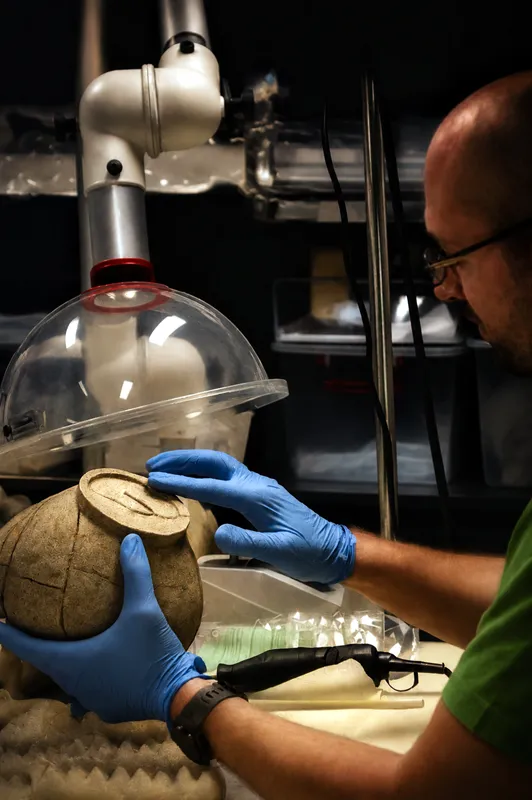
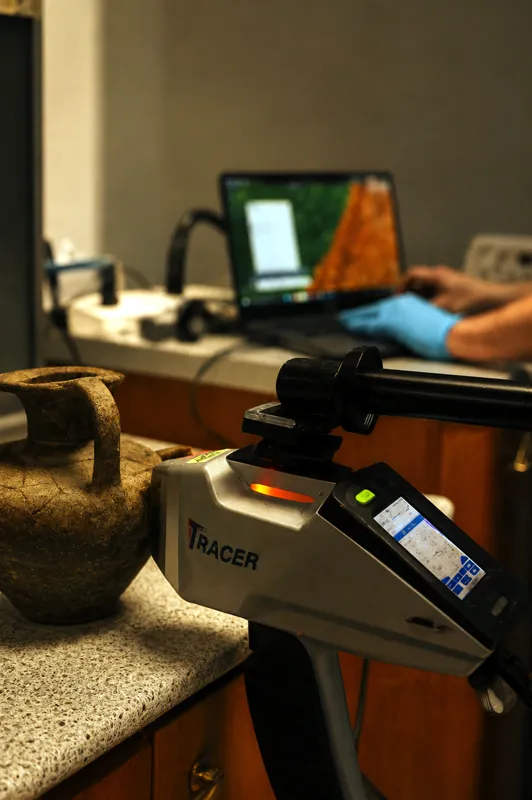
Methodologies are also developed and applied to investigate the authenticity, provenance, and preservation of cultural heritage objects, with emphasis on non-destructive or minimally destructive approaches. The research activities further extend to the analysis of archaeological assemblages and the investigation of relationships among materials, technology, and the environment across different historical periods.
In addition, the Laboratory investigates the use of artificial intelligence and data-analysis techniques in the study of cultural heritage objects, with applications including material classification and identification, the analysis of spectroscopic and imaging data, support for provenance studies, and the development of computational tools for processing complex archaeometric datasets.
The research activities are supported by advanced analytical and imaging equipment, as well as extensive experience gained through national and European research projects in archaeometry and cultural heritage. Through collaborations with universities, research centers, museums, and archaeological organizations, the Laboratory contributes to the development and application of innovative, interdisciplinary approaches for the scientific study, documentation, protection, and promotion of cultural heritage objects and materials.