
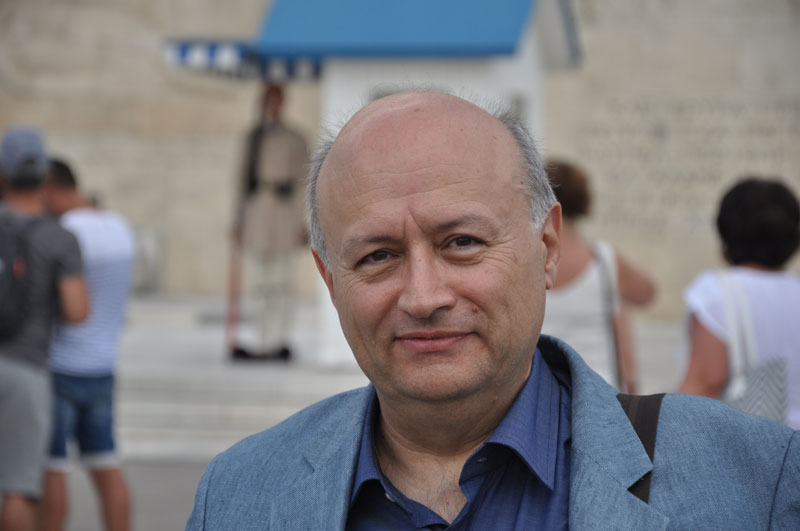
Dr. Nestor Tsirliganis
Research Director
Head of the APML
Nuclear Physicist, PhD
Education
- Ph.D. in Nuclear Science
Department of Nuclear Engineering, University of Michigan – Ann Arbor, USA (1995) - M.Sc. in Nuclear Science
University of Michigan – Ann Arbor, USA (1987) - B.Sc. in Physics
School of Physics, Aristotle University of Thessaloniki, Greece (1986)
CV
Nestor Tsirliganis received his degree in Physics from the Aristotle University of Thessaloniki in 1986. He subsequently continued his studies at the University of Michigan–Ann Arbor, USA, as a Fulbright Foundation scholar, earning a Master’s degree in Nuclear Science in 1987 and a Ph.D. in the same field in 1995. He specialized in nuclear measurements, with particular emphasis on instrumentation and methodologies for neutron detection and measurement.
From 1996 to 1998, he worked as an external research associate at the Laboratory of Nuclear Technology of Democritus University of Thrace, focusing on natural radioactivity and environmental dosimetry. In 1999, he served as an external consultant for the design and establishment of the Laboratory of Archaeometry at the Cultural and Educational Technology Institute of the Athena Research Center, now part of the Institute for Language and Speech Processing, Xanthi Division. The Laboratory was established to apply scientific methods to the extraction of archaeological and historical information from cultural heritage objects.
In 2002, he joined the Cultural and Educational Technology Institute as an Assistant Researcher and Head of the Laboratory of Archaeometry, now the Laboratory of Archaeometry and Physicochemical Measurements. He has held this position ever since and has served as Research Director since 2007. Following the merger of the Cultural and Educational Technology Institute with the Institute for Language and Speech Processing, he served as Head of the Xanthi Division of the Institute for Language and Speech Processing from 2012 until February 2024.
His research interests include luminescence dosimetry and dating, environmental, accident, and space dosimetry, applications of electromagnetic radiation and nuclear measurements in materials, environmental, and cultural heritage sciences, as well as applications of information and communication technologies in everyday life, including the primary sector and healthcare, and in the field of culture.
He has authored more than 70 publications in international peer-reviewed scientific journals, with an h-index of 21, and has participated in 70 international conferences with published proceedings. His published work also includes two theses, four book chapters, and a number of articles in online journals and general-interest magazines. His work has received more than 1,300 citations.
He has participated as Principal Investigator and/or Coordinator in seven national projects, two cross-border projects, one European project, and four research infrastructure projects. From 2020 to 2023, he served as Coordinator and Principal Investigator of the project “AGRO4+: A Holistic Approach to Agriculture 4.0 for New Farmers,” funded under the Operational Programme Competitiveness, Entrepreneurship and Innovation through the “Support for Regional Excellence” action, with a total budget of €3.16 million.
He is a member of the American Nuclear Society, IEEE, the IEEE Computer Society, the IEEE Nuclear and Plasma Sciences Society, and the Hellenic Society for Archaeometry.